
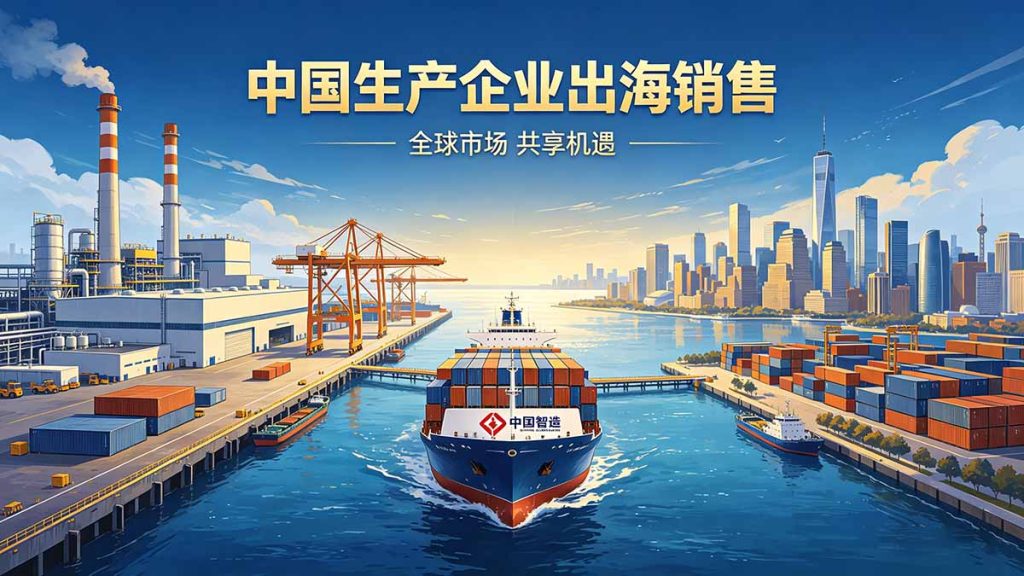
Sailing Global, Breaking Growth Barriers: Practices and Exploration of Overseas Sales for Chinese Manufacturing Enterprises
In today’s deeply integrated global economy, overseas expansion is no longer an exclusive choice for large corporations, but a must-have path for Chinese manufacturing enterprises to break through domestic market competition bottlenecks and achieve scalable growth. From small home appliance factories in the Pearl River Delta, to mechanical equipment manufacturers in the Yangtze River Delta, and light industry producers in central and western China, a growing number of Chinese manufacturing enterprises are stepping out of domestic “involution”, setting their sights on the vast global market, advancing steadily from “Made in China” to “Intelligent Manufacturing in China” and “Chinese Brands”, and seizing their rightful place in the restructuring of the global industrial chain.
The rise of overseas sales for Chinese manufacturing enterprises is driven by both historical opportunities and the inherent needs of corporate development. Externally, adjustments to the global trade landscape and the popularization of the digital economy have created unprecedented convenience for enterprises to expand overseas. The rise of cross-border e-commerce platforms has broken the geographical limitations of traditional foreign trade, allowing small and medium-sized enterprises (SMEs) to directly connect with global end consumers without relying on traditional foreign traders. The entry into force of regional trade agreements such as RCEP has reduced intra-regional trade tariffs and barriers, opening a green channel for Chinese manufacturing enterprises to enter markets in Southeast Asia, Oceania and beyond. Meanwhile, the restructuring of the global supply chain has made more countries recognize the stability and cost-effectiveness of China’s supply chain, actively seeking cooperation with Chinese manufacturers and creating a favorable market environment for overseas expansion.
Internally, intensifying domestic market competition, overcapacity, severe homogenization, and shrinking profit margins have pushed many manufacturing enterprises into development dilemmas. Overseas sales not only help digest excess capacity, but also open up new growth space, enhancing corporate profitability and brand influence. For example, the domestic small home appliance market is highly competitive, with leading enterprises cutting prices to seize market share, leaving small and medium-sized manufacturers struggling to survive. In contrast, emerging markets such as Southeast Asia and the Middle East have strong demand for small home appliances and high price sensitivity. Chinese small home appliance manufacturers, leveraging their mature supply chains and high cost-performance ratio, have quickly penetrated local markets, achieving double growth in sales and profits. In addition, overseas sales force enterprises to improve product quality and technical standards, participate in global market competition, drive industrial transformation and upgrading, and form a virtuous development cycle.
Today, overseas sales for Chinese manufacturing enterprises have formed a diversified development path, no longer limited to the traditional OEM (Original Equipment Manufacturer) model, but presenting a multi-level structure of “OEM + independent overseas sales + brand overseas expansion”. The traditional OEM model remains the starting point for many SMEs to go global: it has low barriers and risks, requires no large investment in brand building and marketing, and allows enterprises to quickly achieve profitability by relying on their production advantages to provide OEM services for overseas brands. However, this model has obvious drawbacks: enterprises lack pricing power, earn meager profits, and are overly dependent on overseas brands, facing survival crises once cooperation terminates.
As enterprises grow in strength, more and more manufacturers are turning to independent overseas sales, directly selling products to end consumers through cross-border e-commerce platforms, offline overseas channels and other means. The rise of cross-border e-commerce has made this model feasible: enterprises can sell products worldwide through platforms such as Amazon, AliExpress and Shopee, eliminating intermediate links and increasing profit margins. Meanwhile, enterprises can obtain user feedback through these platforms, understand market demand, reverse-guide product R&D and optimization, and improve product market adaptability. For example, a home furnishing manufacturer in the Pearl River Delta initially relied on OEM with thin profits, then expanded overseas independently via cross-border e-commerce. It optimized product design and functions based on overseas consumer demand, created differentiated products, not only boosting sales but also building a loyal user base and gradually establishing its own brand recognition.
Brand overseas expansion is the advanced stage of Chinese manufacturing enterprises’ global journey, and the core path for long-term development. An increasing number of Chinese manufacturers recognize that only by building independent brands can they gain a firm foothold in the global market, enhance product added value and core competitiveness. In recent years, a number of Chinese manufacturing enterprises have emerged in the global market with high-quality products and precise market positioning. For example, Haier and Midea in the home appliance industry, Sany Heavy Industry in the mechanical equipment industry, and MINISO in the light industry have all achieved a leap from “selling products” to “selling brands” through brand overseas expansion. These enterprises not only focus on product quality and technological innovation, but also attach importance to localized operation, respect local cultural customs and consumption habits, build localized marketing teams and service systems, and enhance the localized influence of their brands.
In terms of target market selection, Chinese manufacturing enterprises have adopted a strategy of “deepening traditional markets and expanding emerging markets”. Europe and the United States, as traditional mature markets with strong purchasing power and standardized market rules, are important target markets for Chinese manufacturers, but they also face high market access thresholds, fierce competition and strict compliance requirements, making them suitable for enterprises with certain strength and brand foundation. In contrast, emerging markets such as Southeast Asia, the Middle East, Latin America and Africa, with large population bases, rapid economic growth, increasing e-commerce penetration and relatively moderate market competition, have become new blue oceans for Chinese manufacturing enterprises to expand overseas. The consumer demand in these emerging markets is highly compatible with China’s supply chain, with broad market space for small home appliances, home goods, mechanical equipment and light industrial products. For example, consumers in the Middle East value product cost-performance ratio and appearance design, making Chinese small home appliances and home decor products popular among local consumers; Southeast Asia has a young population and huge consumption potential, becoming one of the core markets for Chinese cross-border e-commerce exports.
Despite the favorable development opportunities for Chinese manufacturing enterprises’ overseas sales, the path to global expansion is not smooth, and many challenges remain. First is compliance risk: different countries and regions have distinct trade policies, tax regulations, intellectual property protection laws and product standards. Many enterprises, due to lack of understanding of local compliance requirements, are prone to violations, facing fines, product delisting and even market exit risks. For example, European and American markets have strict environmental and safety standards for products, leading to many Chinese manufacturers being unable to enter the market due to non-compliant products.
Second is cultural differences and market adaptability issues: there are significant differences in cultural customs, consumption habits and aesthetic preferences across countries and regions. Many enterprises, when expanding overseas, lack in-depth research on local markets and blindly replicate domestic products and marketing models overseas, resulting in products failing to meet local consumer demand and struggling to open up markets. For example, a Chinese clothing manufacturer sold domestically popular styles to the Middle East, which failed to align with local consumers’ dressing habits and religious beliefs, leading to poor sales.
In addition, logistics, warehousing and supply chain management are also major challenges for enterprises going global. Overseas logistics costs are high and delivery times are slow, especially in emerging markets with underdeveloped logistics infrastructure, prone to cargo delays and losses; meanwhile, insufficient overseas warehousing layout prevents enterprises from responding to consumer orders in a timely manner, affecting user experience. In addition, exchange rate fluctuations, rising raw material prices and other factors also increase the cost and risk of overseas expansion, bringing uncertainty to corporate profitability.
To achieve sustainable development in overseas sales amid these challenges, Chinese manufacturing enterprises need to make comprehensive preparations, deploy precisely and advance steadily. First, enterprises must strengthen compliance management, deeply understand the trade policies, product standards, intellectual property protection and other relevant regulations of target markets, ensure products and operations meet local requirements, and avoid compliance risks. They can also leverage professional compliance service institutions to improve corporate compliance capabilities and reduce overseas expansion risks.
Second, enterprises should conduct in-depth research on target markets, understand local cultural customs, consumption habits, market demand and competitive landscape, optimize product design and functions based on local market characteristics, create differentiated products, and improve product market adaptability. Meanwhile, they should focus on localized operation, build localized marketing teams and service systems, adopt marketing methods easily accepted by local consumers, and enhance the localized influence of their brands. For example, strengthen brand promotion through local social media, offline exhibitions and other channels to increase brand awareness; provide localized after-sales services to improve user experience and build a loyal user base.
Third, enterprises should optimize logistics, warehousing and supply chain management, reasonably deploy overseas warehouses, establish partnerships with local logistics companies to improve logistics efficiency and reduce logistics costs; meanwhile, strengthen supply chain resilience to address risks such as rising raw material prices and exchange rate fluctuations, ensuring supply chain stability. In addition, enterprises should increase investment in technological innovation and product R&D, improve product quality and technical standards, build core competitiveness, break away from reliance on low-cost advantages, and achieve the transformation from “Made in China” to “Intelligent Manufacturing in China”.
With the continuous recovery of the global economy and the development of the digital economy, Chinese manufacturing overseas expansion is faced with both opportunities and challenges. Going global is not an overnight achievement; it requires long-term persistence, continuous investment, continuous optimization of development strategies and improvement of corporate strength. It is believed that with policy support, market promotion and corporate efforts, more and more Chinese manufacturing enterprises will go global, shine in the global market, achieve the leap from “product export” to “brand export” and “industrial export”, promote Made in China to the world, and write a new chapter in the overseas expansion of Chinese enterprises